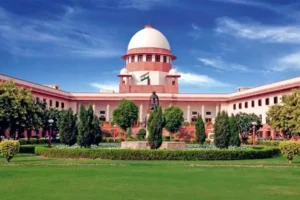
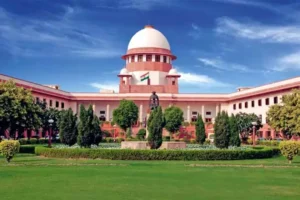


New Delhi, April 15, 2025 – In a judgment that underscores India’s rich linguistic tapestry and the constitutional ethos of unity in diversity, the Supreme Court has dismissed an appeal challenging the use of Urdu alongside Marathi on the signboard of the Municipal Council in Patur, Akola district, Maharashtra. The ruling, delivered by Justices Sudhanshu Dhulia and K. Vinod Chandran in Mrs. Varshatai W/o Sh. Sanjay Bagade v. The State of Maharashtra & Ors. (Civil Appeal Nos. [Redacted] of 2025), not only affirms the legality of bilingual displays but also delves into the historical and cultural significance of Urdu, urging a spirit of openness and tolerance toward languages.
The case originated from the appellant’s objection to the Municipal Council’s signboard, which prominently features “Municipal Council, Patur” in Marathi at the top, with its Urdu translation below. As a former council member, Varshatai argued that all municipal activities, including signage, must exclusively use Marathi, the state’s official language under the Maharashtra Official Languages Act, 1964, and later reinforced by the Maharashtra Local Authorities (Official Languages) Act, 2022. She contended that Urdu’s inclusion violated these provisions and government directives mandating 100% use of Marathi in official proceedings.
The controversy began when the appellant raised her grievance before the Municipal Council. On February 14, 2020, the council, by a majority resolution, rejected her objection, justifying the bilingual approach due to a significant Urdu-speaking population among its members and residents. This practice, the council noted, dated back to its establishment in 1956, serving as an effective means of communication without impeding official work in Marathi.
Undeterred, the appellant invoked Section 308 of the Maharashtra Municipal Councils, Nagar Panchayats and Industrial Townships Act, 1965 (1965 Act), filing an application before the Akola Collector to suspend the resolution. The Collector allowed the plea on December 15, 2020, directing the council to adhere strictly to Marathi in government proceedings, citing a state circular.
Aggrieved council members challenged this before the Amravati Divisional Commissioner under Section 318 of the 1965 Act. On April 30, 2021, the Commissioner set aside the Collector’s order, prompting the appellant to file Writ Petition No. 2219 of 2021 before the Bombay High Court (Nagpur Bench). Here, the respondents raised a preliminary objection on maintainability: post a 2018 amendment to Section 308(1), the Collector can suspend a council resolution only upon an application by the Chief Officer, not a private individual. The pre-amendment provision allowed suo motu action or public complaints if the resolution risked public injury, annoyance, or breach of peace. The amended version restricts initiation to the Chief Officer when resolutions contravene the Act, rules, or government directions.
The High Court, in its June 30, 2021 order, upheld the objection, deeming the appellant’s application non-maintainable. On merits, it noted that government circulars cannot override statutory provisions, and Urdu’s inclusion on the signboard—recognized under the Eighth Schedule of the Constitution—did not violate any law. The writ was dismissed.
The appellant then approached the Supreme Court via SLP (Civil) No. 13820 of 2021. During proceedings, the 2022 Act came into force, mandating Marathi for all local authority interfaces, including signboards, with English as an exception for specific communications. On April 29, 2022, the Supreme Court disposed of the SLP, noting the new enactment rendered the High Court’s order unsustainable, but granted liberty to challenge the Act.
Seizing this, the appellant filed fresh writs before the High Court, arguing the 2022 Act prohibited Urdu. In its April 10, 2024 order, the High Court reiterated that the Act ensures Marathi as the primary language but does not bar additional languages for signage. It quashed a related communication by the council’s administrator but dismissed the main petition, emphasizing language as a tool for communication.
In the ensuing civil appeals, the Supreme Court concurred with the High Court. Justice Dhulia, authoring the judgment, began with a quote from Algerian author Mouloud Benzadi: “When you learn a language, you don’t just learn to speak and write a new language. You also learn to be open-minded, liberal, tolerant, kind and considerate towards all mankind.” This set the tone for a discourse on linguistic harmony.
The Court affirmed the maintainability issue under the amended Section 308, holding that the Collector’s order was void ab initio as it stemmed from an unauthorized application. On merits, it rejected the appellant’s rigid interpretation of the 2022 Act, clarifying that Section 3 mandates Marathi for official purposes but permits additional languages like Urdu—listed in the Eighth Schedule—for effective public interface. Sub-section (2) allows English for complex communications, but no blanket prohibition exists on other scheduled languages.
Delving deeper, the judgment celebrated India’s multilingualism, noting over 122 major languages and 270 mother tongues per censuses. It recounted the Constituent Assembly’s debates, where Hindustani (a blend of Hindi and Urdu) was nearly adopted as the national language but faltered post-Partition due to Urdu’s association with Pakistan. Citing Granville Austin’s analysis, the Court lamented how Partition “killed Hindustani,” leading to Hindi’s Sanskritization and Urdu’s Persianization, exploited by colonial divides.
The bench referenced Article 345, empowering states to adopt multiple languages, as evidenced by states like Bihar and Uttar Pradesh designating Urdu as a second official language. It upheld the Uttar Pradesh Hindi Sahitya Sammelan ruling (2014), affirming legislatures’ flexibility to add languages without exhausting powers.
Emphasizing Urdu’s Indo-Aryan roots and shared grammar with Hindi, the Court quoted scholars like Gyan Chand Jain and Ram Vilas Sharma, asserting Urdu and Hindi as variants of one language, separated by “political expediency, not linguistic reality.” It highlighted Urdu’s influence on legal terminology (e.g., adalat, halafnama) and everyday Hindi, rejecting prejudices linking Urdu solely to religion.
The ruling promoted tolerance, viewing languages as cultural bridges, not barriers. Dismissing the appeals, the Court found no legal infirmity, reinforcing that bilingual signboards enhance accessibility without violating Marathi’s primacy.
This verdict has broader implications for linguistic rights amid rising regionalism. Legal experts praise it for fostering inclusivity, potentially influencing similar disputes. With over 900 words in analysis, it serves as a reminder: in India’s diverse mosaic, languages unite, not divide.
(Word count: 892)